
Candela vs Lumens vs Lux: What Really Determines Lighting Performance?
When comparing automotive LED lights, lumens usually get most of the attention. But a higher lumen rating does not automatically mean better visibility or longer beam distance.
The discussion of candela vs lumens vs lux is vital for understanding lighting technology.
To understand how an LED driving light actually performs, you need to look at four key factors:
Lumens + Candela + Lux + Beam Pattern
Understanding Candela vs Lumens vs Lux
Each tells you something different about how a light produces, projects, and distributes illumination.
To fully grasp the concept of candela vs lumens vs lux, it’s important to consider their individual roles.
Lumens vs Candela vs Lux: Quick Comparison
| Measurement | What It Measures | Why It Matters |
| Lumens (lm) | Total light output | Shows how much visible light is produced |
| Candela (cd) | Light intensity in a specific direction | Helps indicate beam concentration and long-range performance |
| Lux (lx) | Light reaching a surface | Shows illumination at a specific distance |
| Beam Pattern | Light distribution | Shows where the usable light actually goes |
Understanding these measurements makes it much easier to compare LED driving lights, fog lights, auxiliary lights, and off-road lighting systems.
Ultimately, your choice should be informed by a clear understanding of candela vs lumens vs lux.
What Are Lumens?
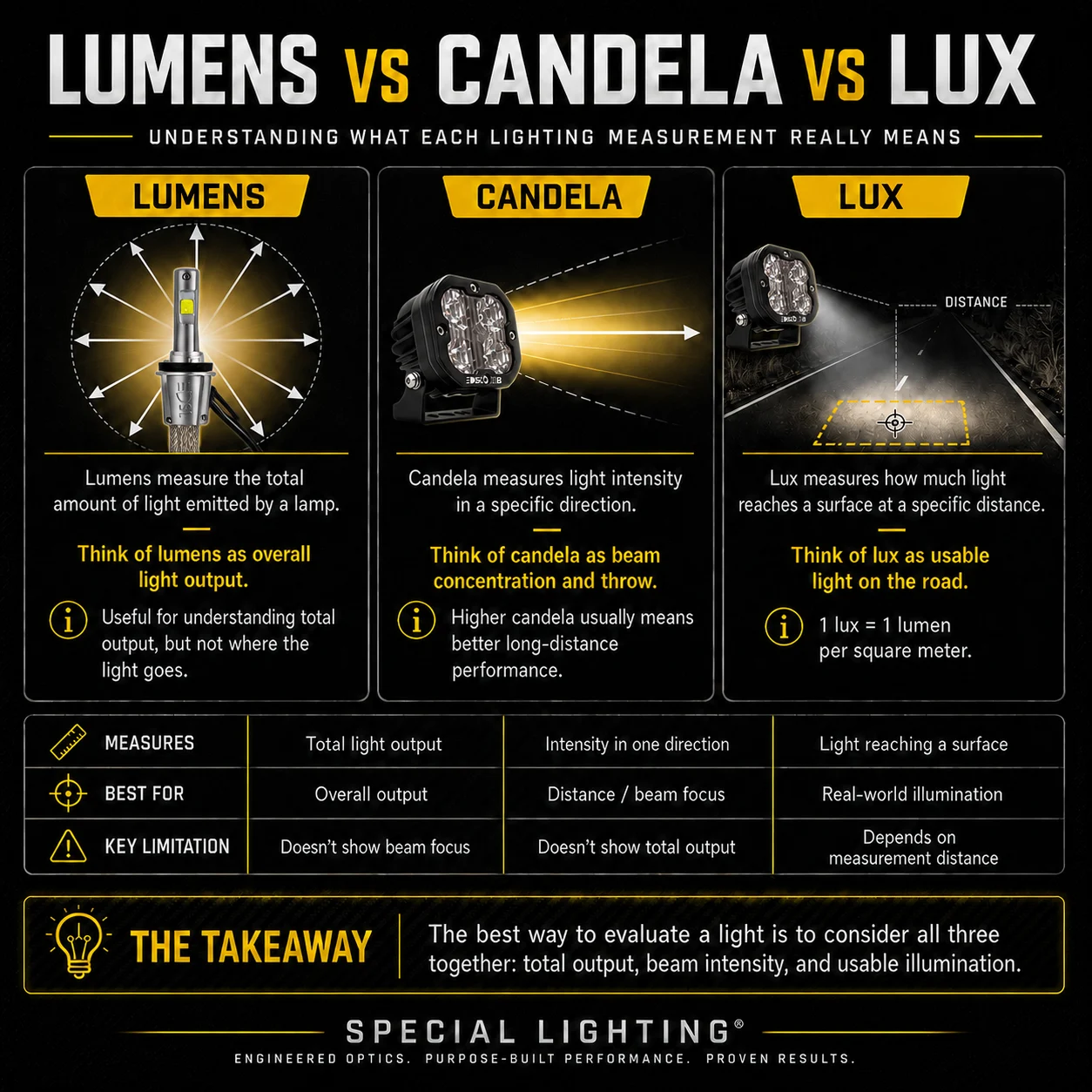
Lumens measure the total amount of visible light produced by a light source.
A higher lumen output means more total light is available, but it does not tell you where that light is going.
For example, an LED light producing 10,000 lumens could spread much of its output across a wide area, while an 8,000-lumen light with optimized optics could concentrate more useful illumination farther down the road.
This is why lumens alone should not be used to compare automotive LED lights.
For applications requiring detailed lighting assessments, candela vs lumens vs lux are critical measurements.
Raw Lumens vs Real-World Performance
Raw lumens describe the potential output of the LEDs before the light passes through reflectors, lenses, and other optical components.
The final performance depends heavily on how efficiently the optical system controls that light.
Two lights with similar raw lumen ratings can therefore produce completely different beam patterns and driving performance.
What Is Candela?
Candela measures luminous intensity in a specific direction.
While lumens tell you how much light exists, candela tells you how strongly that light is being projected in a particular direction.
This makes candela especially important for:
- Driving lights
- Spot lights
- Long-range auxiliary lights
- High-speed off-road lighting
A well-designed driving light can concentrate more of its available output toward the road ahead, producing higher peak candela and better long-distance visibility.
A simple way to remember the difference:
Lumens = Quantity
Candela = Intensity
What Is Lux?
Lux measures how much light reaches a surface.
One lux equals one lumen per square meter.
For automotive lighting, lux is particularly useful because it can show how much illumination actually reaches the road or a measurement target.
But there is one important rule:
Lux Must Include Distance
Understanding how candela vs lumens vs lux interact helps in making the right lighting choices.
A specification such as:
598 lux
provides very little useful information without knowing the measurement distance.
Instead, look for specifications such as:
598 lux @ 10 meters
Illumination decreases as distance increases, so the measurement distance is essential when comparing lighting performance.
This is also why strong optical control matters: the better the reflector or lens controls the available light, the more effectively it can place illumination where the driver needs it.
candela vs lumens vs lux
Real-World Example: CAVOK X8
This example illustrates the relationship between candela vs lumens vs lux in practical terms.
The relationship between lumens, candela, and lux becomes much clearer when comparing two beam configurations of the same lighting platform.
Consider the Special Lighting® CAVOK X8.
| Specification | High Driving | Combo |
| Raw Output | 8,129 lm | 8,050 lm |
| Peak Intensity | 99,000 cd | 46,750 cd |
| Illuminance @ 10 m | 978 lux | 598 lux |
| Color Temperature | 6000K | 6000K |
The difference in raw lumen output is only about 1%.
Yet the High Driving version produces more than twice the peak candela.
Why?
The optics distribute the available light differently.
The High Driving configuration concentrates more intensity toward long-range forward visibility.
The Combo configuration distributes more of the available light laterally, balancing distance with wider coverage.
Neither beam pattern is inherently better. They are engineered for different purposes.
This demonstrates why comparing automotive lights by lumens alone can be misleading.
Why Beam Pattern Matters
Even lumens, candela, and lux do not tell the complete story.
You also need to know where the light goes.
A properly engineered beam pattern controls the available output according to the intended application:
Driving: concentrated forward illumination for distance.
When evaluating performance, keep candela vs lumens vs lux in mind for accurate comparisons.
Combo: balance between forward distance and lateral coverage.
Flood: wide illumination for nearby areas.
Fog: controlled, wide beam designed for low mounting positions and foreground coverage.
This is why two LED lights using similar LEDs — or even producing similar lumen output — can perform very differently on the road.
What Makes a High-Performance LED Driving Light?
Automotive lighting performance depends on the complete optical and electrical system, including:
-
- LED positioning
- Reflector geometry
Remember, candela vs lumens vs lux provide a comprehensive understanding of lighting efficiency.
- Lens design
- Optical efficiency
- Thermal management
- Driver electronics
- Beam distribution
Powerful LEDs are only one part of the equation.
For optimal results, always compare using the metrics of candela vs lumens vs lux.
At Special Lighting®, our goal is not simply to generate more light. It is to create usable illumination through purpose-built optical systems.
What Should You Look for When Buying LED Driving Lights?
Incorporating candela vs lumens vs lux into your evaluations can significantly enhance your outcomes.
When comparing LED auxiliary lights, don’t look at the advertised lumen number alone.
Instead, evaluate:
Lumens: How much total light is available?
Candela: How concentrated is the beam?
Assessing products based on candela vs lumens vs lux can lead you to the best options for your needs.
Lux at a defined distance: How much illumination reaches the target?
Beam pattern: Where is the light distributed?
Real beam images: Does the actual beam match your intended application?
Controlled testing: Are the specifications supported by measurements rather than marketing claims?
A light with fewer advertised lumens can outperform a higher-lumen competitor if its optical system puts more usable light where the driver actually needs it.
Lumens vs Candela vs Lux: Which Is Most Important?
To ensure effectiveness, never forget the critical differences between candela vs lumens vs lux.
There isn’t one measurement that determines overall lighting performance.
For automotive applications:
Lumens tell you how much light is available.
Candela tells you how strongly that light is projected in a particular direction.
Lux tells you how much illumination reaches a surface at a specified distance.
Beam pattern tells you where that illumination is distributed.
Together, they provide a much more accurate picture of real-world performance.
Frequently Asked Questions
Exploring candela vs lumens vs lux will clarify common misconceptions about lighting.
- Are lumens or candela more important for driving lights?
Both matter, but they describe different characteristics. Lumens measure total light output, while candela measures intensity in a particular direction. For long-range driving lights, candela is particularly useful for understanding beam concentration.
- Does higher candela mean a light shines farther?
Generally, higher intensity along the beam axis can produce more illumination at longer distances. However, beam pattern and optical design must also be considered.
- What does lux @ 10 meters mean?
It indicates how much illumination reaches the measurement surface 10 meters from the light. Including the distance makes lux measurements meaningful and easier to compare.
For comprehensive comparisons, always factor in candela vs lumens vs lux.
- Can two LED lights have the same lumens but different performance?
Absolutely. Different reflectors, lenses, and optical designs can distribute similar lumen output very differently.
- Are raw lumens the same as usable light?
No. Raw lumens describe the potential output of the LEDs. Real-world performance also depends on optical efficiency, beam distribution, thermal management, and the complete lighting system.
Focusing on candela vs lumens vs lux will guide your decision-making process.
The Bottom Line
The best automotive lighting isn’t necessarily the light with the biggest lumen number.
Real performance comes from controlling the available light and putting it where the driver needs it.
When comparing LED driving lights, evaluate:
Ultimately, a clear grasp of candela vs lumens vs lux is essential for effective lighting solutions.
Lumens + Candela + Lux + Beam Pattern
That combination provides a much better understanding of real-world lighting performance than lumens alone.
In summary, understanding candela vs lumens vs lux leads to better lighting choices.
For anyone serious about lighting, a thorough analysis of candela vs lumens vs lux is crucial.