
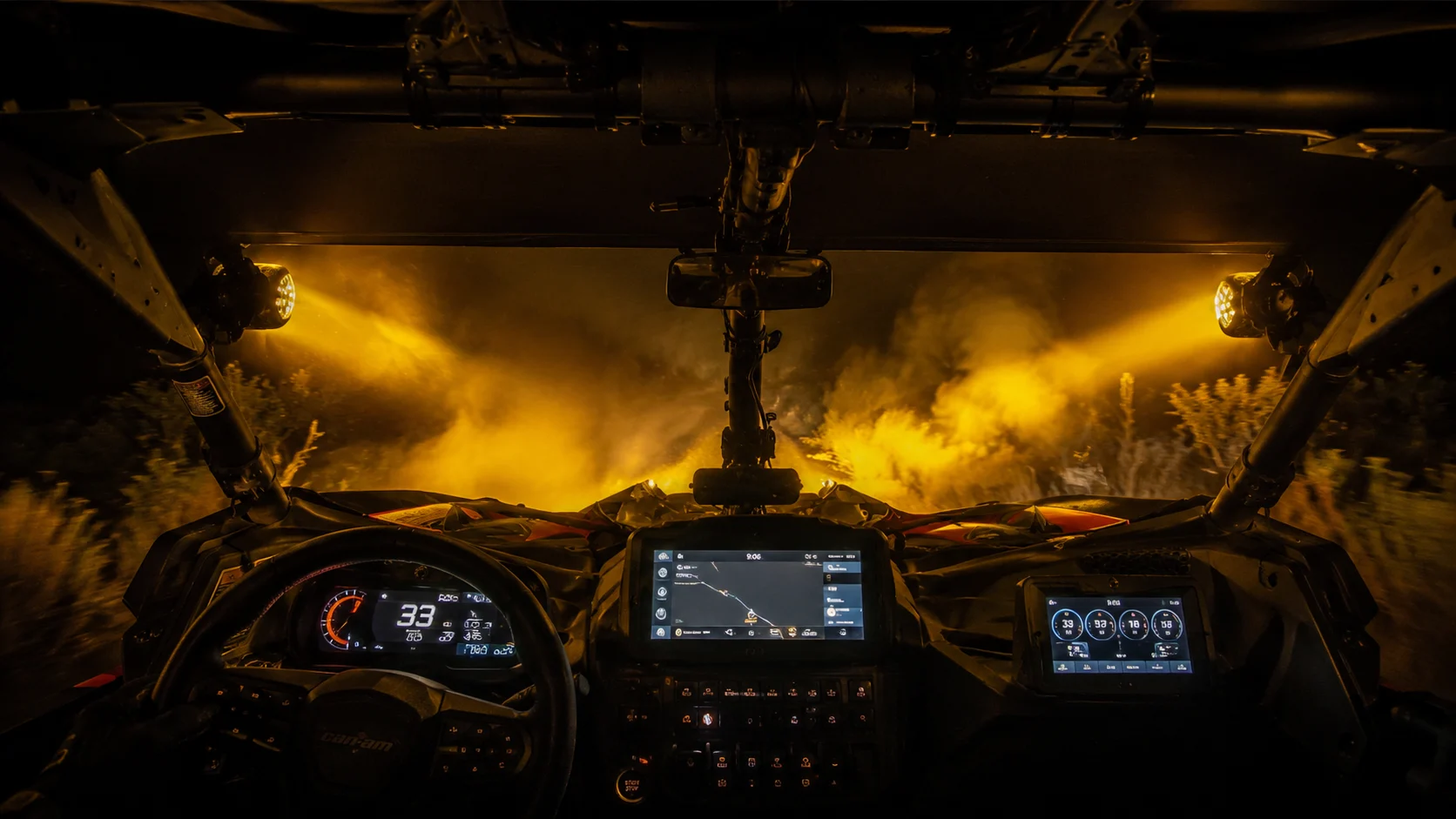
Where to Buy Amber Pod Lights for Off-Road & Outdoor Use
Where can you buy amber pod lights that are actually built for off-road use?
The answer depends on more than finding the highest-rated pair on a marketplace.
Amber LED pods can look remarkably similar in product photos, yet differ significantly in optical performance, beam control, housing construction, environmental protection, wiring quality, and warranty support. For a light that will be exposed to vibration, dust, rain, mud, heat, and repeated trail use, those differences matter.
Before deciding where to buy amber pod lights, it helps to understand what makes a good amber off-road light in the first place.
This guide explains when amber lighting makes sense, which specifications deserve your attention, how to compare different types of LED pods, and what to check before placing an order.
Why Choose Amber Pod Lights for Off-Road Driving?
Amber lighting has become increasingly popular on off-road trucks, SUVs, UTVs, and overland builds because it can be particularly useful in difficult driving conditions.
Compared with cool-white automotive lighting, amber or warm-yellow light contains less short-wavelength blue light. In conditions involving airborne dust, rain, snow, fog, or highly reflective surfaces, many drivers find this warmer spectrum produces less distracting perceived glare and better visual contrast.
That does not mean amber light magically “cuts through” fog while white light cannot.
Visibility in adverse weather depends on several factors, including:
- beam pattern
- optical control
- mounting height
- aiming
- intensity
- color spectrum
- environmental conditions
Color is only one part of the system.
A poorly controlled amber flood light can still create excessive glare, while a properly engineered white light can perform extremely well when the beam is placed where the driver actually needs it.
When does amber make the most sense?
Amber pod lights are particularly useful for:
- dusty off-road trails
- rain and wet-road conditions
- foggy environments
- snow
- bumper-mounted auxiliary lighting
- ditch or cornering lights
- trail lighting
- low-mounted auxiliary lights
For clear conditions where maximum distance and detail are the priority, high-output white lighting may still be the better choice.
This is why many serious off-road lighting systems combine both colors rather than treating amber and white as competitors.
Special Lighting, for example, recommends a combination of 6000K white and 3000K amber Sigma X5 lights in its Toyota Land Cruiser 250 lower-grille system, using white for distance and clarity and amber for improved contrast in adverse conditions.
What to Look for When Buying Amber Pod Lights
Choosing an amber pod light should involve much more than comparing advertised lumen numbers.
A high-performance auxiliary light is an optical system. LEDs generate the light, but the optics determine where that light actually goes.
These are the specifications that deserve the most attention.
1. Beam Pattern
Beam pattern should be one of your first considerations.
Different mounting locations require different types of illumination.
| Application | Useful Beam Characteristics |
|---|---|
| Fog / adverse weather | Wide, controlled illumination |
| Ditch lights | Wide peripheral coverage |
| Bumper auxiliary lights | Driving or Combo |
| Long-range trail lighting | Driving / Spot |
| General off-road use | Combo |
| Work or camp lighting | Flood |
A common mistake is assuming that every amber light should have the widest flood beam possible.
That isn’t necessarily true.
A very wide beam can illuminate objects close to the vehicle, but it can also sacrifice useful forward projection. For general trail driving, a properly engineered Combo beam can provide a better balance between distance and peripheral visibility.
The important question isn’t simply:
How wide is the beam?
It’s:
Where is the usable light being placed?
2. Don’t Judge Pod Lights by Lumens Alone
Lumens are useful, but they tell only one part of the story.
Lumens
Measure the total amount of light produced.
Candela
Measure the intensity of light in a particular direction.
Lux
Measure how much light reaches a surface at a given distance.
Two lights can advertise similar lumen output while producing dramatically different usable beams.
One may spread most of its light close to the vehicle.
Another may use its optical system to project significantly more usable light down the trail.
That is why serious comparisons should consider:
Lumens + Candela + Lux + Beam Pattern + Optical Design
rather than focusing on lumens alone.
Special Lighting uses this same philosophy in its published technical content, emphasizing that producing light is only the first step; controlling where that light goes determines how useful it becomes.
3. Optical Design Matters
The LEDs themselves are only one component of an auxiliary light.
The optical system controls how the available output is collected, redirected, and projected onto the road or trail.
Common systems include:
- reflector optics
- projector-style optics
- TIR optics
TIR stands for Total Internal Reflection.
A properly engineered TIR optic can capture and redirect LED output into a highly controlled beam pattern, allowing the designer to determine how much light is used for forward projection versus peripheral illumination.
TIR is not automatically superior to every reflector system. Excellent lights can be designed using different optical technologies.
What matters is the finished result:
usable width + distance + intensity + beam control
The Sigma X5 uses an optical-grade TIR system to produce its Combo Driving + Flood beam.
4. Understand IP Ratings Before Buying
Off-road lights are routinely exposed to environments that consumer lighting products rarely experience.
Think:
- rain
- standing water
- mud
- dust
- pressure washing
- stream crossings
This is where IP ratings become important.
IP67
Commonly associated with dust protection and temporary water immersion.
For many outdoor applications, this represents a reasonable baseline.
IP68
Designed for immersion conditions beyond those covered by IP67, under conditions specified for that particular product.
Do not assume every IP68 product has exactly the same allowable immersion depth or duration. Check the manufacturer’s specifications.
IP69K
Addresses resistance to close-range, high-pressure, high-temperature water jets and is particularly relevant to vehicles and equipment that may be aggressively washed after exposure to dirt or mud.
An important distinction:
IP67, IP68, and IP69K should not simply be interpreted as a good-better-best ranking.
They address different environmental exposures.
For an off-road vehicle, think about how the light will actually be used and cleaned.
The Sigma X5, for example, is currently specified by Special Lighting as IP69K and also lists IK10 impact compliance and MIL-STD-810G testing among its published construction specifications.
5. Housing and Lens Construction
A weatherproof rating alone does not tell the complete durability story.
An off-road pod also needs to survive:
- constant vibration
- impacts
- changing temperatures
- UV exposure
- dirt
- repeated heat cycles
Look for manufacturers that clearly identify the materials used in the housing and lens rather than relying only on phrases such as “heavy duty.”
The Sigma X5 uses a billet-machined aluminum housing and optical-grade polycarbonate lens, according to Special Lighting’s published specifications.
6. Wiring Harness and Installation Hardware
This is one of the most overlooked parts of buying auxiliary lights.
A pair of lights is not particularly useful if, after opening the box, you discover that you still need:
- relay
- fuse
- switch
- connectors
- wiring
- mounting hardware
Before ordering, check exactly what is included.
A properly designed auxiliary-light installation should use electrical components sized for the actual current draw of the lighting system.
For multi-light systems, current demand becomes even more important.
Also verify whether your installation requires vehicle-specific brackets. Universal mounting hardware may work for custom installations, while locations such as factory fog-light openings, lower grilles, A-pillars, and hidden bumper mounts often require dedicated brackets.
For Sigma X5, Special Lighting currently lists both the wiring harness and mounting hardware as included with the pair.
Where Can You Buy Amber Pod Lights?
There are three main ways to shop for amber auxiliary lighting.
1. Large Online Marketplaces
Large marketplaces offer enormous selection and can be useful when price is the primary consideration.
The challenge is comparing products accurately.
Specifications may be inconsistent between sellers, performance claims can be difficult to verify, and warranty or technical support can vary considerably.
If choosing this route, don’t rely only on:
- review count
- star rating
- product photos
- advertised lumen output
Look for complete technical specifications.
2. Specialty Off-Road Retailers
Specialty retailers generally make it easier to compare established automotive-lighting products.
They may also provide:
- vehicle fitment information
- installation accessories
- technical assistance
- off-road-specific product categories
This can be a good option when comparing several manufacturers before deciding on a lighting system.
3. Buy Directly From an Off-Road Lighting Manufacturer
Buying directly from the manufacturer can make sense when technical information, warranty coverage, replacement parts, and installation support are priorities.
Before choosing any manufacturer, look for transparent information about:
- beam pattern
- color temperature
- power consumption
- optical design
- environmental protection
- materials
- included accessories
- warranty terms
Claims such as “ultra bright” or “extreme output” mean very little without measurable specifications behind them.
Special Lighting Sigma X5: A Premium Amber Pod Option
For drivers looking for a premium amber auxiliary light, the Special Lighting Sigma X5 is available in a 3000K amber configuration for adverse-weather and off-road applications. Special Lighting also uses amber Sigma X5 units in its recommended mixed-color Land Cruiser 250 lighting system.
The Sigma X5 platform combines:
- 5-inch auxiliary-light format
- optical-grade TIR optics
- Combo Driving + Flood beam
- billet-machined aluminum housing
- optical-grade polycarbonate lens
- IP69K protection
- IK10 impact compliance
- included wiring harness
- included mounting hardware
- amber DRL backlight
- Limited Lifetime Warranty
Rather than designing the product around lumen output alone, the Sigma X5 optical system is intended to combine strong forward projection with usable peripheral illumination.
For drivers who frequently encounter both clear trails and adverse conditions, combining 6000K white and 3000K amber lighting can provide a more versatile system than choosing either color exclusively.
What to Check Before Ordering Amber Pod Lights
Before clicking the buy button, run through this checklist:
Color
Do you need amber for adverse conditions, white for maximum clarity and distance, or a combination of both?
Beam Pattern
Does the beam fit the mounting location and intended use?
Optical Performance
Does the manufacturer publish more than a lumen number?
Look for information about:
- beam pattern
- candela
- lux
- optical design
Environmental Protection
Is the light designed for the dust, water, washing, and exposure your vehicle will actually encounter?
Materials
What are the housing and lens made from?
Electrical Requirements
What is the current draw?
Is the supplied wiring appropriate for the system?
What’s Included?
Confirm:
- harness
- relay
- fuse
- switch
- mounting hardware
Vehicle Fitment
Do you need a vehicle-specific bracket?
Warranty
Read the actual warranty terms instead of relying on a warranty logo alone.
Amber vs. White: Which Should You Buy?
If you drive primarily in clear, dry environments and want maximum forward visibility, white auxiliary lighting will usually be the natural starting point.
If you regularly drive through:
- dust
- rain
- fog
- snow
- highly reflective conditions
then adding amber lighting can make the system more comfortable and versatile.
And if your vehicle sees both types of conditions, the answer may not be amber or white.
It may be:
Amber + White
A mixed system allows each color to perform the job it is best suited to do.
Frequently Asked Questions
Where can I buy amber pod lights for off-road use?
Amber pod lights are available through major online marketplaces, specialty off-road retailers, and directly from lighting manufacturers. For serious off-road use, prioritize manufacturers or retailers that publish detailed specifications for beam pattern, optical performance, environmental protection, construction, and warranty rather than choosing a product based only on price or marketplace reviews.
Are amber pod lights better than white lights?
Neither color is universally better.
Amber lighting can be particularly useful in dust, rain, fog, snow, and other conditions where reducing distracting glare and improving perceived contrast are important.
White light is generally preferred when maximum clarity, natural color perception, and long-range nighttime illumination are the priority.
Many off-road vehicles benefit from using both.
Is 3000K considered amber for off-road lights?
In the off-road lighting market, 3000K is commonly used to describe a warm yellow or amber-style output.
However, color temperature and true spectral output are not exactly the same measurement. When comparing lights, use the manufacturer’s actual color description and specifications rather than assuming every product marketed as amber produces identical light.
Is amber better for driving in dust?
Amber lighting can be advantageous in dusty environments because its warmer spectrum can reduce the harsh visual effect created when intense cool-white light illuminates airborne particles directly in front of the vehicle.
Beam placement and intensity remain extremely important. Color alone cannot compensate for a poorly designed or badly aimed beam.
What beam pattern is best for amber pod lights?
It depends on the application.
Wide controlled patterns work well for peripheral visibility and adverse-weather applications, while Driving and Combo beams provide greater forward projection for trail use.
For general off-road driving, a properly engineered Combo pattern can offer a useful balance between forward distance and width.
What IP rating should off-road pod lights have?
There is no single IP rating that covers every type of exposure.
IP67 and IP68 primarily address water immersion at different levels, while IP69K addresses high-pressure, high-temperature water exposure.
Choose a product whose environmental protection matches how the vehicle will actually be used, submerged, and washed.
Are lumens the most important specification for LED pod lights?
No.
Lumens indicate total light output, but they do not tell you where that light goes.
Candela, lux, beam pattern, and optical design are equally important when evaluating how effectively an auxiliary light illuminates the road or trail.
Choosing Amber Pod Lights Built for Real Off-Road Use
The best amber pod lights are not necessarily the lights with the largest lumen number, the most reviews, or the lowest price.
A properly engineered off-road lighting system brings several factors together:
color + optics + beam pattern + intensity + durability + electrical design + installation + warranty
Amber lighting can be an excellent tool for dust, rain, fog, snow, and other challenging environments, but the quality of the optical system remains just as important as the color of the light itself.
For drivers looking for a premium off-road solution, Special Lighting Sigma X5 is available in 3000K amber configurations and combines TIR optical technology, a Combo Driving + Flood beam, IP69K protection, included wiring and mounting hardware, and Special Lighting’s Limited Lifetime Warranty.
Explore Sigma X5 3000K Amber →